

Express Accounts
Express accounts let platforms onboard users who don’t yet have a Meteroid account and who should not manage their billing entities directly. You create a connected account on their behalf, send them an onboarding link, and they complete a short setup wizard — all within a platform-branded experience. Meteroid handles organization creation, tenant provisioning, and invoicing entity setup automatically. Once onboarding completes, you can make API calls on behalf of the connected account using your own API key and thex-meteroid-connect-account header.
Express accounts are ideal for platforms where end users should not need to understand Meteroid internals. For users who already have a Meteroid account and want to connect it themselves, see Standard Accounts (OAuth).
Express vs. Standard
Getting Started
1. Enable Connect
Navigate to Developers > Connect Platform in your Meteroid dashboard, then click Enable Platform. This activates the Connect feature for your organization.2. Configure Branding (Optional)
In the Platform Settings tab, you can set a branding invoicing entity. The onboarding wizard will display your company logo and name in its sidebar, giving end users a branded experience.3. Create a Connected Account
From the Connected Accounts tab, create a new Express account by providing the end user’s email and organization name. You can optionally pre-fill a country and attach metadata for your own reference. Meteroid generates a single-use onboarding link that you send to the user — via email, in-app notification, or any channel you prefer.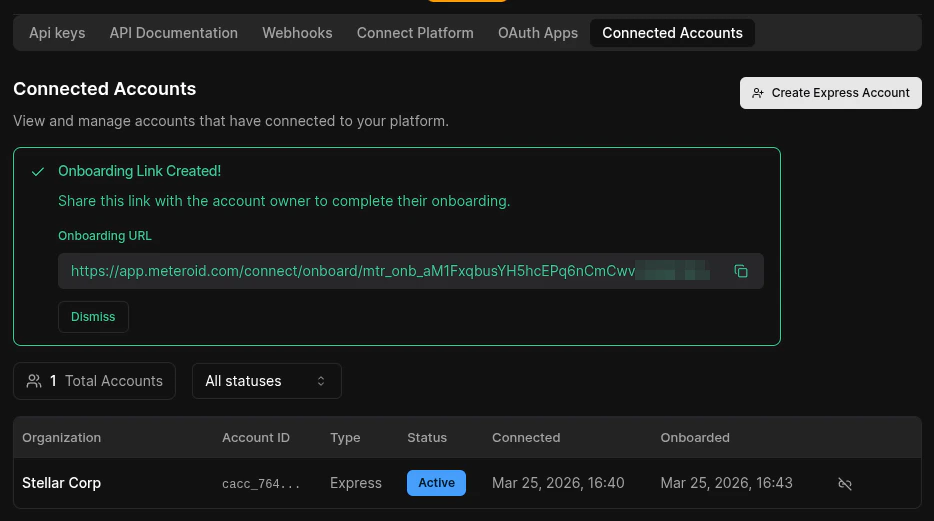
You can also create connected accounts and generate onboarding links programmatically via the API. See the API Reference for details.
The Onboarding Wizard
When the user opens the onboarding link, they see a guided wizard with your platform branding.Step 1 — Authentication
- If the user already has a Meteroid account, they sign in with their existing credentials.
- If not, they enter their email, receive a verification link, and set a password to create a new account.
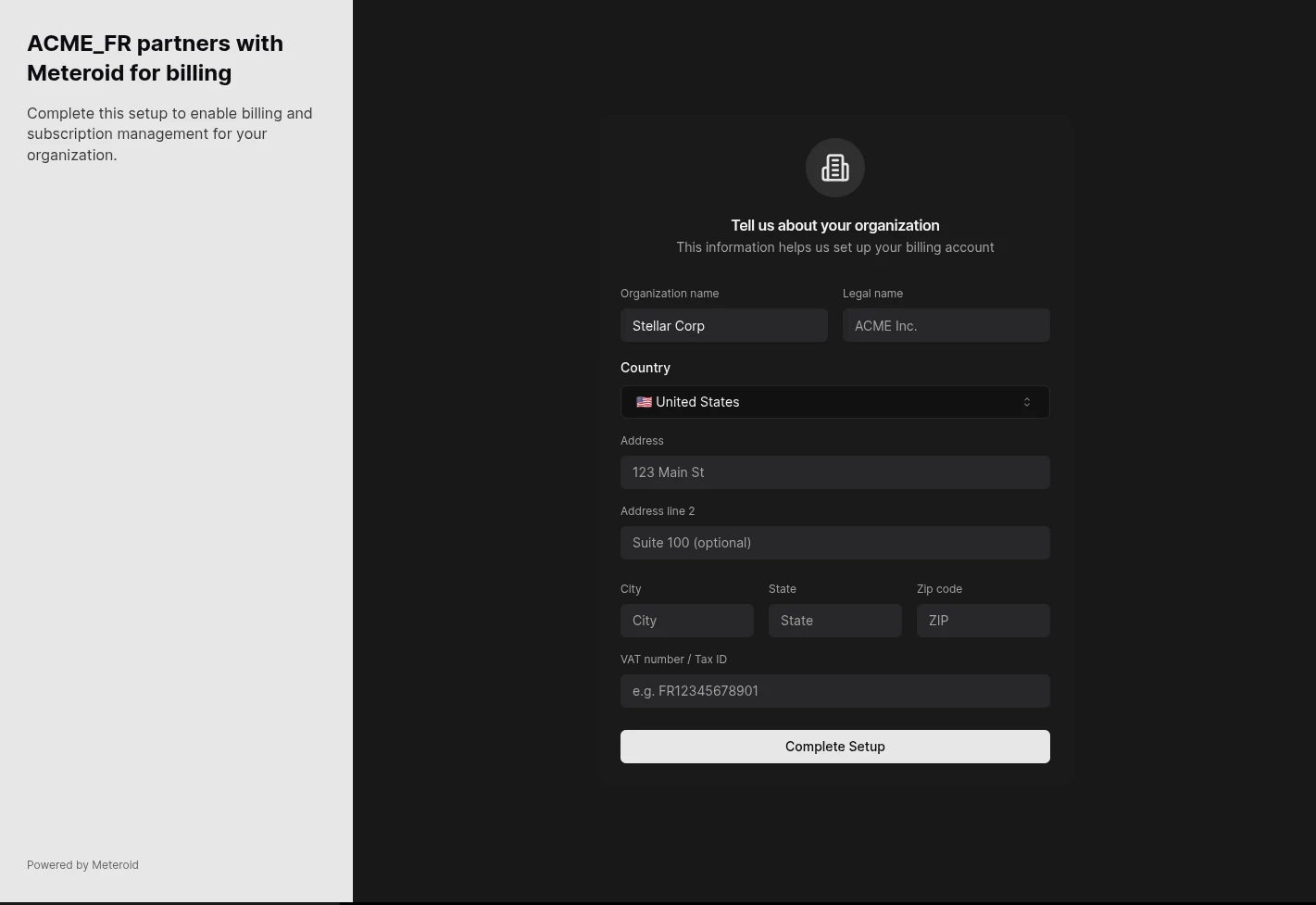
Step 2 — Business Information
The user reviews and completes their organization details:- Organization name — pre-filled from what the platform provided, editable by the user
- Country — pre-filled if the platform specified one
- Legal name, address, VAT number — optional fields used for invoicing
Completion
On submission, Meteroid automatically:- Creates a new organization and production tenant for the user
- Sets up an invoicing entity with the billing details provided
- Marks the connected account as Active
- Redirects the user back to the platform’s specified redirect URL
Onboarding Links
Onboarding links are single-use and time-limited (7 days by default). Once the user completes onboarding, the link cannot be reused. If a link expires or you need to resend, you can generate a new one from the Connected Accounts tab or via the API — without creating a new connected account.Account Lifecycle
A connected account moves through a series of states:Acting on Behalf of a Connected Account
Once an account is Active, you can make API calls scoped to the connected organization by passing thex-meteroid-connect-account header with your own API key — similar to Stripe’s Stripe-Account header.
The connected account must be Active. Requests targeting Pending, Suspended, or Revoked accounts are rejected.